Combating Hate Speech and Disinformation to Protect Women’s Political Participation. Policy brief
The brief documents how hate speech, gendered disinformation and online violence in Armenia undermine women’s political participation and electoral integrity and calls for a coordinated package of legal, regulatory, educational and support measures to protect women, improve public debate quality, and safeguard democratic elections.
Key findings
Widespread problem: Hate speech, gendered disinformation and online attacks against women are pervasive in Armenian media and social networks, intensifying around elections and reducing women’s visibility and willingness to participate in politics.
Severe impact on women: Monitoring and surveys show high exposure and serious consequences for women in public life, including withdrawal from political activity and feelings of legal insecurity.
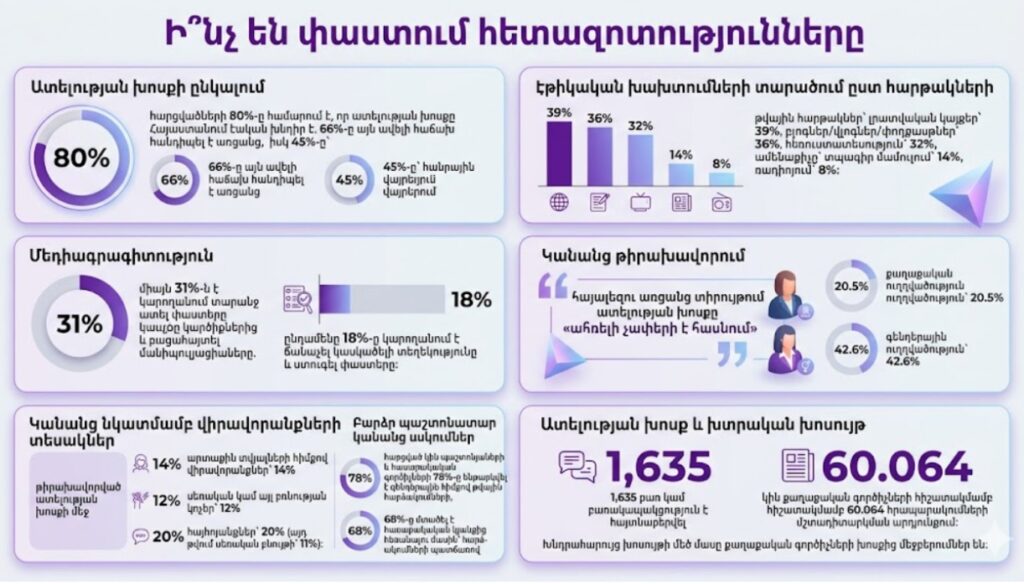
Evidence and key statistics available (collected from the research implemented during the last two years, as well as within the framework of this project: Monitoring of 60,064 items identified 1,635 words/phrases classified as hate speech, sexism or discrimination; most incidents appear on news websites (39%), blogs/vlogs/podcasts (36%) and TV (32%).)
Perception of hate speech — 80% of respondents consider hate speech to be a significant problem in Armenia; 66% encounter it more often online, and 45% encounter it in public places.
Distribution of ethical violations by platform — digital platforms: news websites 39%, blogs/vlogs/podcasts 36%, television 32%; least in print media 14%, radio 8%.
Media literacy — only 31% can distinguish facts from opinions and detect manipulations; only 18% can recognize suspicious information and verify facts.
Targeting of women — in Armenian-language online spaces hate speech reaches “alarming levels”: 20.5% is politically directed; 42.6% is gender-directed.
Types of insults against women — among targeted hate speech: insults based on appearance 14%, calls for sexual or other violence 12%, general insults 20% (including sexual-nature insults 11%).
Attacks on high-ranking women — 78% of surveyed women office-holders and public figures have experienced gender-based digital attacks; 68% have considered withdrawing from public life because of the attacks.
The brief references Armenia National legislation, including constitutional guarantees and laws addressing hate speech, discrimination and media regulation (Constitution; Criminal, Civil and Administrative Codes; media and advertising laws), as well as journalistic codes of ethics, outlines CEDAW, UN strategies on hate speech, the Rabat Plan of Action, Council of Europe recommendations, the Istanbul Convention and GREVIO guidance as normative bases for distinguishing legitimate speech from harmful, gendered disinformation and for guiding proportional responses as well as presents the implementation gaps.
Policy priorities and recommended actions
Prevention and monitoring — establish continuous, election-period monitoring of gendered disinformation and online hate; apply Rabat criteria to assess risk.
Protection and support — create rapid-response mechanisms, ensure legal and psychosocial support for targeted women, and improve reporting channels.
Media and platform accountability — enforce media standards; strengthen moderation and self-regulation to reduce discriminatory content; ensure balanced coverage of female and male candidates.
Media literacy and training — scale public media-literacy campaigns and provide digital-safety training for women in public life; train journalists and political actors on gender-sensitive communication.
Institutional reforms and international cooperation — clarify and strengthen law enforcement and regulatory practice; align national policies with UN, CoE and OSCE guidance; use international best practice to design effective countermeasures.
The Policy Brief was created by the “Women’s Information and Analytical Network” NGO (WomenNet NGO) within the framework of the project “Promoting Gender-Sensitive Communication and Preventing Disinformation in Electoral Processes.” This project is implemented under the “ProElect – Promote accountability in Electoral processes in EaP through increased participation and capacity of civic actors” programme, carried out in partnership with the Transatlantic Foundation and ERIM, and funded by the European Union.
This publication was created and maintained with the financial support of the European Union and Equal Rights & Independent Media (ERIM). Its contents are the sole responsibility of Women’s Information-Analytical Network NGO and do not necessarily reflect the views of the EU and ERIM.